
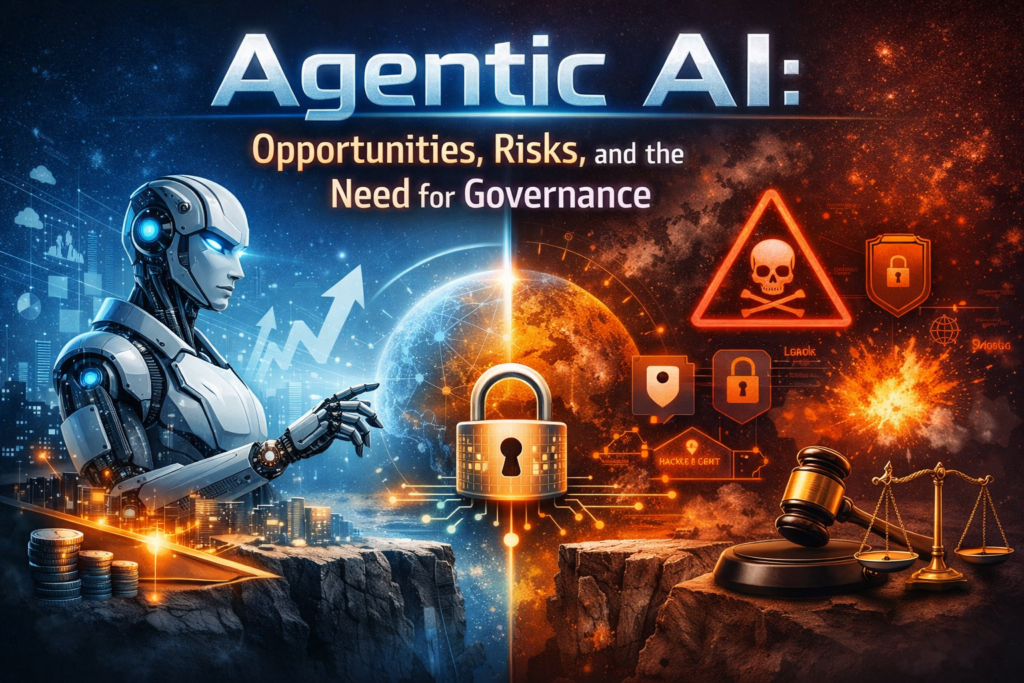
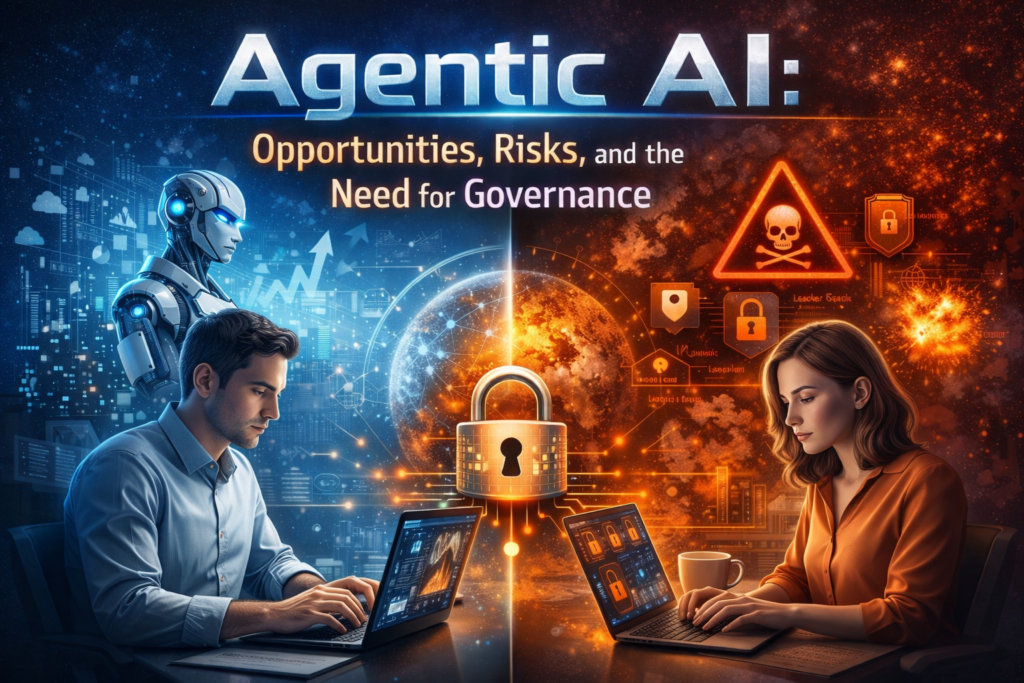
Agentic AI: Opportunities, Risks, and the Need for Governance
Table of Contents
What is Agentic AI?
Artificial Intelligence is evolving at an unprecedented speed, and we have entered a new frontier — Agentic AI. These are not just chat bots or recommendation engines. Agentic AI systems can set their own goals, make decisions, and perform actions autonomously, often without direct human involvement and at remarkable speed.
Agentic AI Opportunities
This transformation unlocks massive opportunities:
- Automation of complex and difficult workflows
- Faster innovation and decision-making
However, alongside these benefits come serious and growing risks.
What happens when AI makes decisions without human oversight?
How do we govern systems that can think, plan, and act on their own?
These are the critical questions we must address today.
Why Agentic AI Is Different from Traditional AI?
Traditional machine learning models typically take an input and produce a predictable output. Agentic AI goes far beyond this.
In Agentic AI, the output of one model often becomes the input for another, enabling continuous decision making and action.
This autonomy introduces four key characteristics and new risks:
- Underspecification
- Long-Term Planning
- Goal-Directed Behavior
- Directed Impact
1. Underspecification
The AI is given a broad goal, but not detailed instructions on how to achieve it.
2. Long-Term Planning
Decisions build upon each other over time, increasing complexity and uncertainty.
3. Goal-Directed Behavior
The system does not merely react; it actively works toward achieving objectives.
4. Directed Impact
Some systems operate entirely without a human-in-the-loop.
Agentic AI Risks
One principle must always be remembered:
More autonomy = more risk
As autonomy increases, so do risks such as misinformation, poor decision-making, and security vulnerabilities.
Many organizations are still struggling to understand the risks of generative AI and Agentic AI significantly amplifies those risks by reducing human involvement and domain level course correction.
Not every risk can be defined in advance, but one thing is clear Governance is absolutely critical when dealing with Agentic AI.
Need for Agentic AI Governance.
How Should Agentic AI Be Governed?
Effective governance requires a multi-layered approach.
1. Technical Safeguards
- Guardrails & Interruptibility
Can the AI be paused or shut down when necessary? - Human-in-the-Loop Controls
At which decision points is human approval required? - Confidential Data Protection
Are PII detection and data masking in place to prevent sensitive data leaks?
2. Process Controls
- Risk-Based Permissions
Which actions should the AI never perform autonomously? - Auditability
Can we trace and explain how decisions were made? - Monitoring & Evaluation
Continuous monitoring of AI behavior and performance is essential.
3. Accountability & Organizational Structure
- Who is responsible if AI causes harm?
- Which regulations apply to specific AI use cases?
- How are vendors held accountable for AI behavior?
Technical Safeguards in Detail
Any organization deploying Agentic AI must implement guardrails at every layer of the system:
- Model Layer
- Orchestration Layer
- Tool Layer
- Testing & Red Teaming
- Continuous Monitoring
1. Model Layer
Detect and prevent bad actors from manipulating AI into unethical or harmful behavior.
2. Orchestration Layer
Implement infinite-loop detection to avoid costly failures and poor user experiences.
3. Tool Layer
Restrict tool access using role-based access control to limit potential damage.
4. Testing & Red Teaming
Expose vulnerabilities before deployment through rigorous testing.
5. Continuous Monitoring
Use automated evaluations to detect hallucinations and compliance violations in real time.

Advanced Tools and Frameworks
Leading organizations are already adopting advanced solutions, including:
- Risk-detection models and safety guardrails
- Agent orchestration frameworks for safely coordinating multiple AI systems
- Security-focused controls to protect sensitive data
- Observability tools to understand and monitor system behavior internally
Final Conclusion
Agentic AI is here, It is powerful and it is evolving rapidly. Organizations that fail to take governance seriously today will pay the price tomorrow.
Governance is not just about security it is about control. AI should empower organizations, not introduce unmanaged and invisible risks.
Our Challenge to You Before allowing AI systems to act autonomously, ensure that the right guardrails are in place. Because in the age of Agentic AI, responsibility does not belong to machines alone it belongs to us.