

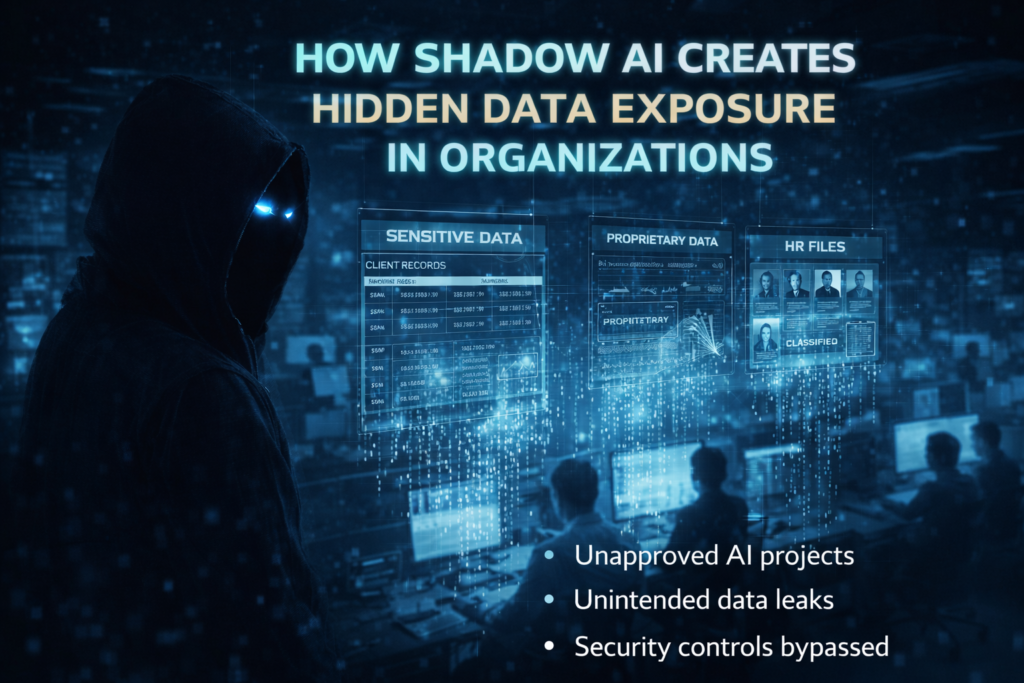
What is Shadow AI?
You might be thinking, “We don’t have any of AI in our corporate environment.”
But the real question is: do you know this for sure, or are you just assuming it? This question is critical, because today a growing risk exists called Shadow AI.
Many people have already seen the power of Generative AI. As a result, employees quietly experiment with AI inside organisations to improve productivity. This often leads to multiple AI projects running at the same time, many of them unsanctioned and unmanaged.

If we are not careful, these projects can turn into serious security risks, especially data leakage.
Table of Contents
What to do for Shadow AI?
The first step is to discover all AI instances in your environment, especially the ones you are not aware of because unknown AI is the real risk.
Once discovered, you must ensure the following things
- Data is never leaked.
- There is no unintended exposure.
- Strong and properly implemented security controls are in place.
In many cases, simply saying “No, don’t do this” is not enough.
A better approach is:
Don’t say “No” instead of this we have to Say “How”.
If you only say “no”, people will still do it just without telling you. Instead, guide them toward the right and secure way, and recommend approved alternatives that allow them to get their work done safely.
How do we discover and secure Shadow AI?
A very good place to start is the cloud. AI models especially large models are compute-intensive and storage-heavy, which makes them expensive to run locally. Most people cannot afford to host them on personal systems, so they are usually deployed in cloud environments.
What Is an AI Deployment?
A typical AI setup includes a model Training or fine-tuning data Applications or agents that interact with the model. These are the components that must be identified and tracked.

How to Identify AI in Cloud Environments?
First, list all cloud environments used by your organisation. Then look for Known AI platforms Self-hosted or open-source models (for example, models downloaded from Hugging Face). In some cases, teams deploy only the model, not a full AI platform. Both scenarios require different discovery techniques.
Practical Discovery Process for AI Shadow
There are following process for discovery of AI Shadow
Using a strong discovery tool for AI Shadow:
- Connect to cloud environments
- Scan for AI models
- Identify associated data:
- Training and fine-tuning data
- RAG (Retrieval Augmented Generation) data
- Identify applications and agents using the model
Once all of this is visualised, you finally have full visibility into Shadow AI.
Posture Management
The next step is AI Security Posture Management.
Key components to secure:
- Data
- Models
- Applications
- RAG data sources
If any one of these is misconfigured or unsecured, it becomes a potential risk.
Security Risks in AI Shadow
There are following risks in AI Shadow
- Data Extraction.
- Access Control Issues.
- Data Poisoning.
- Excessive Agency.
1. Data Extraction
If an attacker gains access to unsecured training data or RAG sources containing sensitive information (such as customer records), they can easily extract that data by querying the model.
2. Access Control Issues
For example, Bob works in accounting and should only access a specific application.
He should not have access to the model, training data, or RAG data.
Excess access increases the risk of mistakes or misuse.
3. Data Poisoning
If an attacker injects incorrect or malicious data into training or RAG datasets, the model will start producing incorrect or harmful outputs.
4. Excessive Agency
If an application is given unnecessary privileges such as modifying models or accessing systems it doesn’t need both bugs and attacks can cause serious damage. This is where the Principle of Least Privilege is essential give only the access that is strictly required.
Visibility and control.
You cannot secure what you cannot see AI Shadow. Therefore from following procedure we can visible it and control it.
- Discover AI models, data, and applications.
- Identify mis-configurations and vulnerabilities.
- Improve your AI security posture.
- Secure existing AI deployments or recommend safer, more private alternatives.
Conclusion
There are following conclusion AI should bring business value, not business risk to achieve this:
- Discover Shadow AI
- Bring it into the light
- Secure it properly
And always remember: Don’t say “No” instead Say “How”. That’s how Shadow AI becomes Helpful AI.

Pingback: Agentic AI: Opportunities, Risks, and the Need for Governance - CyberNilo