

What is a cybersecurity risk assessment?
A cybersecurity risk assessment is a process that helps an organization identify, analyze, and prioritize the potential threats, weaknesses, and security issues that could affect its information systems. The main purpose of this assessment is to reduce risks as much as possible and strengthen the overall security measures of the organization.
A cybersecurity risk assessment is considered a systematic and structured approach that examines all kinds of possible threats and vulnerabilities within an organization’s IT environment. This includes evaluating how these risks might occur, how much damage they can cause, and how the organization should respond to them.
This assessment is an essential part of the organization’s overall cybersecurity strategy. It plays a critical role in protecting sensitive information, information systems, and other important digital assets from various cyberthreats. By conducting a risk assessment, organizations gain a clearer understanding of the risks that could affect their business objectives. It also helps them estimate the likelihood of cyberattacks and the potential impact they might have. Based on this understanding, organizations can form effective recommendations to minimize those risks.
The assessment begins by identifying the organization’s critical assets — such as hardware, software, sensitive data, networks, and other IT infrastructure. Once these assets are identified, the next step is to list down all the possible threats and vulnerabilities. Threats may originate from different sources, including hackers, malware, ransomware, insider threats, or even natural disasters. Vulnerabilities may include outdated or unpatched software, weak or reused passwords, unsecured networks, misconfigured systems, or lack of proper access control.
After identifying threats and vulnerabilities, the risk assessment process evaluates the potential impact and severity of those risks. It also estimates the likelihood of each risk occurring, providing a clearer picture of which risks require immediate attention and which ones can be handled later.
Widely used cybersecurity frameworks such as the NIST Cybersecurity Framework and ISO 27001 offer structured methods for conducting risk assessments. These frameworks guide organizations on how to prioritize risks, manage resources effectively, and improve overall security posture. Some organizations also develop their own customized frameworks to match their specific operational needs. The ultimate goal is to create tools like a risk matrix to rank risks from highest to lowest, enabling better decision-making in cyber risk management.
Conducting regular cybersecurity risk assessments is highly beneficial because it helps organizations stay updated and adaptable in an evolving cyberthreat landscape. Regular assessments allow organizations to continuously protect valuable information assets, reduce vulnerabilities, and meet important regulatory requirements such as GDPR and other compliance standards.
Furthermore, cyber security assessments make it easier to communicate high-risk findings to stakeholders, senior leadership, and other decision-makers. This ensures that leaders have the right information to determine acceptable risk levels and to create stronger and more effective security policies. In the long run, these steps significantly enhance the organization’s overall information security and cyber-security posture, making it more resilient against current and future cyber-threats.
How to perform a cybersecurity risk assessment?
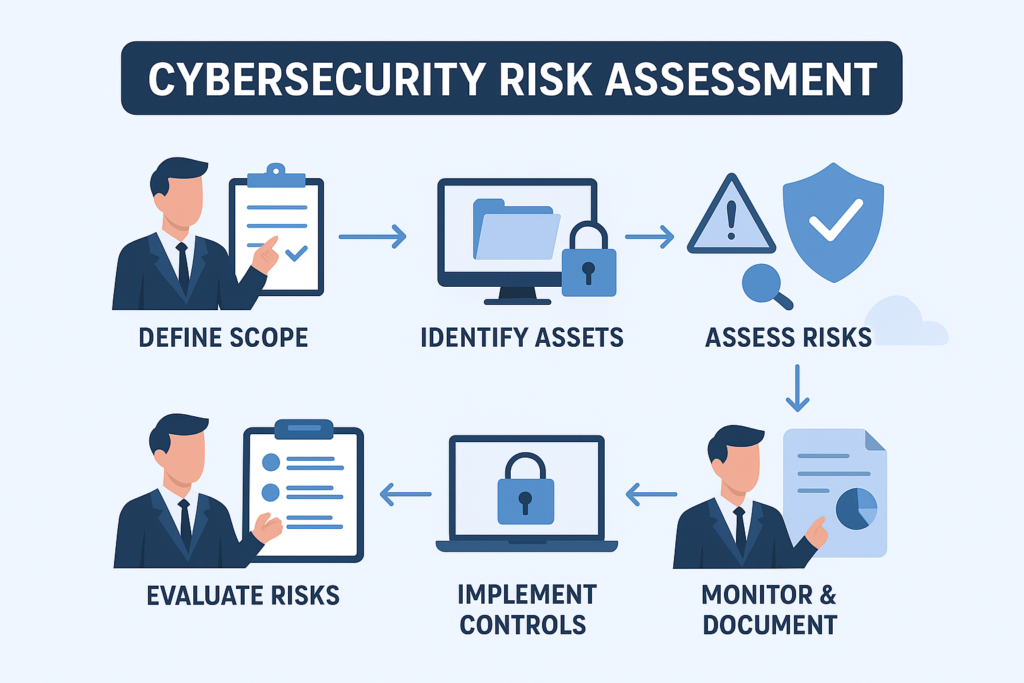
A cybersecurity risk assessment follows a well-structured process that security teams use to identify, evaluate and reduce risks as effectively as possible. Each step plays an important role in strengthening an organization’s overall security posture.
There are following Steps to perform Risk assessment.
- Defining the Scope of the Assessment
- Identifying and Prioritizing Assets
- Assessing and Analyzing Risks
- Identifying Cyber Threats and Vulnerabilities
- Calculating Probability and Impact
- Monitoring and Documenting Results
1. Defining the Scope of the Assessment
The first step is to clearly define the scope of the assessment.
This includes deciding whether the assessment will cover the entire organization or only specific departments, units, locations or business processes.
It is essential to gain support from key stakeholders so everyone involved understands the assessment procedures, terminology, relevant standards and expectations. This ensures smooth coordination throughout the process.
2. Identifying and Prioritizing Assets
In this stage, a detailed audit of IT assets is performed.
This involves creating an updated inventory of all hardware, software, data, networks and other digital resources within the organization.
Assets are then classified based on their value, legal importance and business impact. Critical assets are highlighted for focused protection.
A network architecture diagram is also created to show how assets are interconnected and to identify important entry points within the system.
3. Assessing and Analyzing Risks
Risk analysis focuses on evaluating the likelihood that a threat will exploit a vulnerability and determining the potential impact such an incident could have on the organization.
A risk matrix is used to classify and prioritize risks based on both likelihood and impact.
Important technical factors—such as discoverability, exploitability and reproducibility of vulnerabilities—are also considered during the analysis.
4. Identifying Cyber Threats and Vulnerabilities
This step involves identifying weaknesses (vulnerabilities) such as system misconfigurations, outdated software, unpatched systems, weak passwords and insecure access points.
Threats are also identified, including malware, phishing, ransomware, insider threats and even natural disasters.
Security teams use frameworks like MITRE ATT&CK and the National Vulnerability Database (NVD) to ensure they are referencing accurate, updated and industry-recognized threat information.
5. Calculating Probability and Impact
In this step, the probability of each risk occurring is estimated, meaning how likely an attack or incident is to happen.
Next, the impact of that risk is assessed, including the effect on the confidentiality, integrity and availability of organizational data.
Organizations also quantify the impact in terms of monetary losses, recovery and remediation costs, legal fines and potential damage to their reputation.
6. Monitoring and Documenting Results
The final step in the process involves continuously monitoring the effectiveness of the implemented security controls.
Regular audits, vulnerability scans, and reassessments are conducted to ensure that all controls are functioning properly and remain effective over time.
The entire process — including risk scenarios, assessment results, remediation actions, and progress reports — is thoroughly documented.
The risk register is also kept updated so that stakeholders always have clear, accurate, and current information available to support informed decision-making.
So these are the cybersecurity risk assessment steps it will help to improve cyber security for organisation.